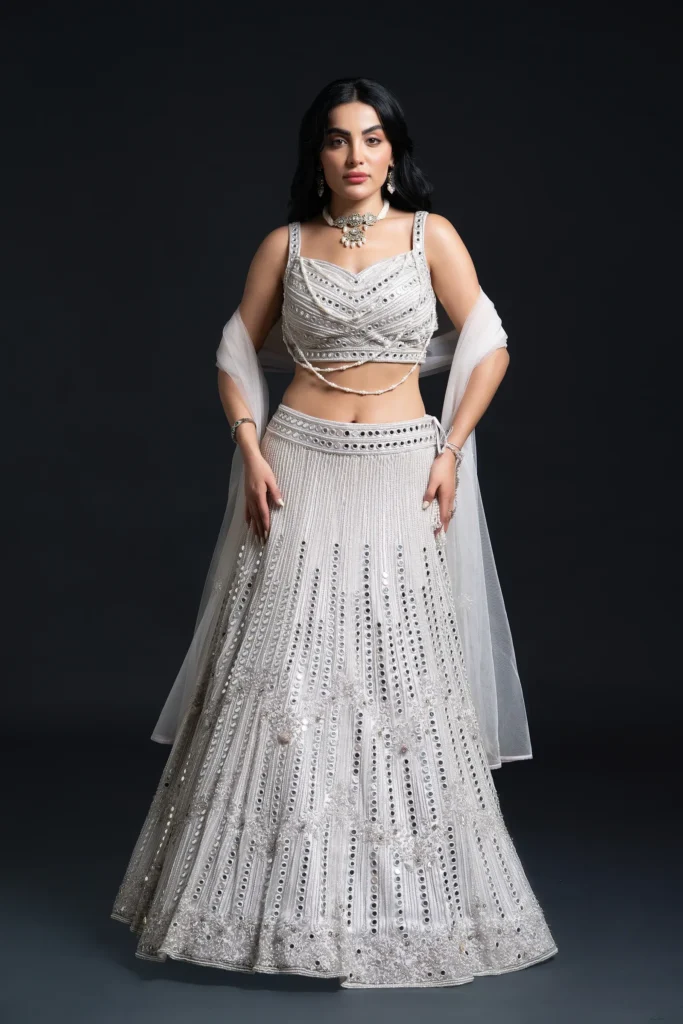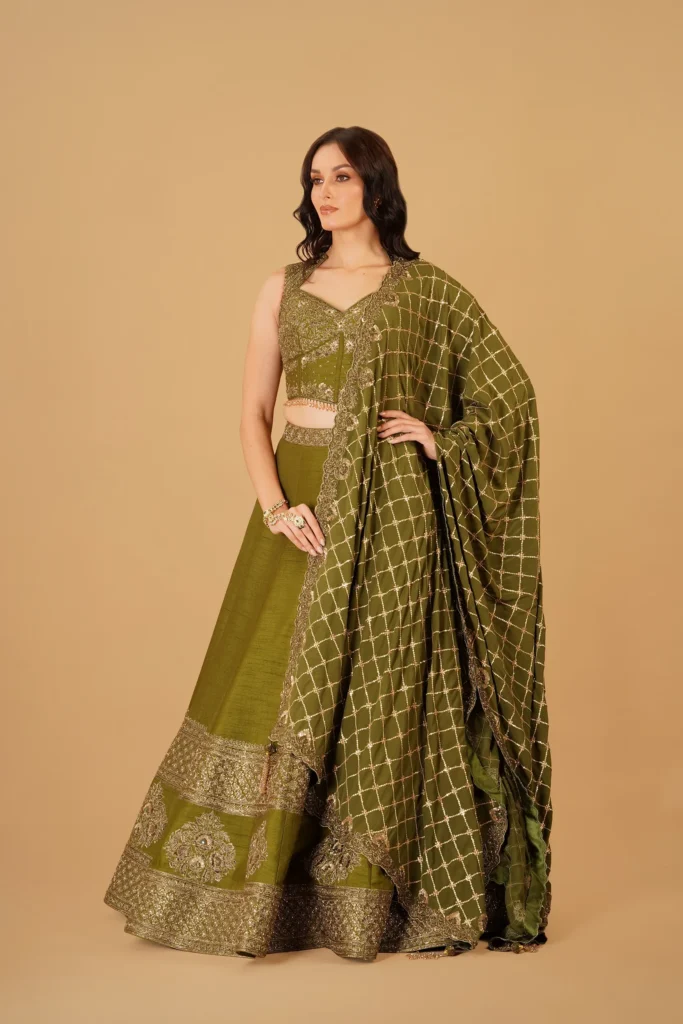
In short: Every Aahana’s by Nidhi Mehra bridal lehenga is made by hand, in-house, by a small team of specialist artisans — a mirror-work specialist, a zardozi master, a resham embroidery artist, and the finishers and tailors who complete each piece. A single intricate bridal lehenga can take around 320 hours across six pairs of hands. This is the story of those hands: how they trained, what they do, and why fair, in-house craftsmanship is the reason your outfit fits and lasts the way it does.
By Nidhi Mehra, couturier and founder of Aahana’s by Nidhi Mehra — a made-to-order bridal atelier in Sector 4, Noida.
When a bride slips into her finished lehenga, she sees one seamless piece. What she doesn’t see is the six weeks it spent on a wooden embroidery frame, the six people who touched it, and the hundreds of hours of hand-work folded quietly into every panel. At Aahana’s, the garment is only half the story. The other half is the people who make it — and I have always believed you cannot understand the value of couture until you meet the hands behind it.
So let me take you behind the seams.
Six Artisans, One Lehenga
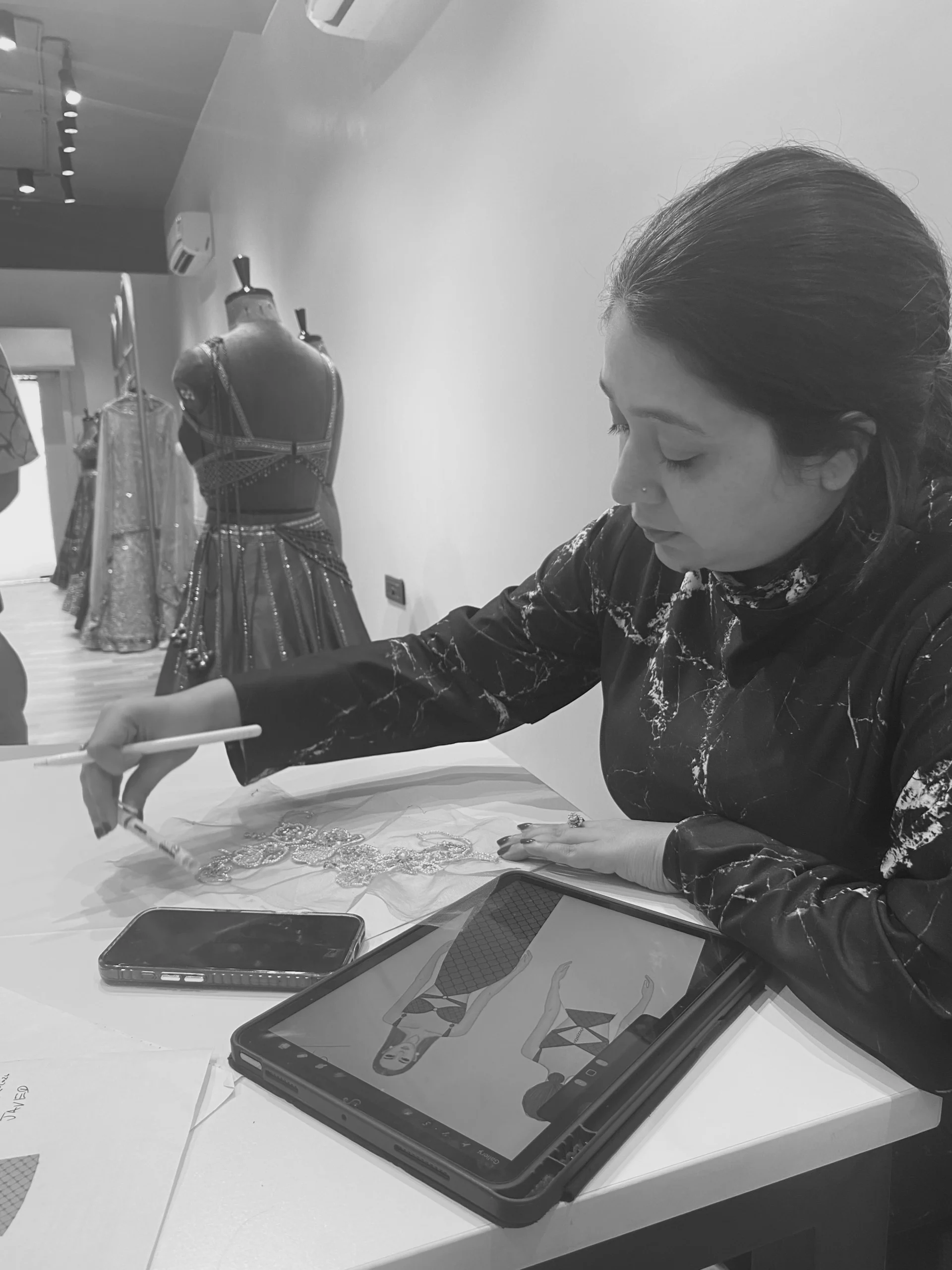
A bridal lehenga is not made by one person. It moves through a small team, each responsible for the part of the craft they have spent years mastering. One specialist may spend two weeks on mirror work alone; another builds gold zardozi motifs thread by thread; a third blends coloured silk into florals that look painted rather than stitched. Then come the finishers and the master tailor, who turn embroidered fabric into a garment that fits one specific bride. That division isn’t assembly-line efficiency — it’s the opposite. It means every section is done by the person who does it best. The portraits below are representative of the artisans in our Noida atelier.
The Mirror-Work Specialist
The first time you watch a mirror-work artisan, it looks like a magic trick: a tiny disc of glass, held in place by nothing, is suddenly locked to the fabric by a frame of thread built stitch by stitch around its edge. This is shisha work, one of the oldest decorative crafts of the subcontinent, and our specialist learned it the traditional way — years of apprenticeship beside an older craftsman, first cutting and sorting mirrors, then practising the anchoring stitch on scrap cloth until it was clean enough to show.
With well over a decade at the frame, the work is now second nature, but the philosophy hasn’t changed: every mirror must sit dead flat and dead centre, because a single tilted disc catches the light wrong and the eye finds it instantly. A typical day is slow and meditative — a few hundred mirrors placed and framed, each checked by hand. What inspires the work, in the artisan’s own words, is the moment the whole panel is lit: “Alone, one mirror is nothing. Together, they become a night sky.”
The Zardozi Master
Zardozi — literally “gold embroidery” — is the craft that gave Indian bridalwear its reputation for opulence, and it carries centuries of history: royal courts, temple textiles, heirlooms passed down through generations. Our zardozi master specialises in raised metallic thread work, building motifs with dabka, kora, and fine wire coiled and couched onto the fabric so the design sits proud of the surface and catches light from every angle.
This craft cannot be rushed or self-taught from a book. It is learned through apprenticeship — our master trained for years under a senior craftsman before being trusted with a bridal panel alone. The hardest part, they will tell you, is consistency of tension: pull the metallic thread a fraction too tight and it puckers the base; too loose and the motif loses its crisp edge. Their favourite designs are the dense, traditional bridal borders — the ones that take longest and reward the closest looking. “A camera sees the colour,” they say. “Only the eye, up close, sees the hours.”
The Thread-Embroidery Artist
Where zardozi is about metal and structure, resham work is about colour and softness. Our thread-embroidery artist works in fine silk floss, blending shades within a single flower so a petal shifts from deep rose to blush the way a real one does. It is painterly work, and it takes an artist’s eye as much as a craftsman’s hand — knowing which three tones of green will read as one leaf under warm evening light, and how to shade a motif so it looks dimensional rather than flat.
Quality, for this artisan, is about the back of the fabric as much as the front: neat, secure, tail-free stitching that will survive years of wear and a lifetime as an heirloom. They are particular about materials, preferring high-grade silk thread that holds colour and sheen rather than cheaper substitutes that dull over time. Ask what they enjoy most and the answer is simple: “When a bride touches the flowers and asks if they are painted. That is the whole day, made worth it.”
The Finishers, the Tailor, and the Coordinator
Three more pairs of hands complete the team. The bead-and-cutdana finisher adds the final layer of detail — scattered sequins, pearl accents, crystal highlights placed one at a time to lift the embroidery without overwhelming it. It is precise, patient work, and it is what separates a piece that looks rich from a distance from one that rewards a close, second look.
The master tailor is where embroidered fabric becomes a garment. Building a lehenga is structural work — a full-flare skirt must hold its shape and its embroidery weight without collapsing, a choli must fit one specific body precisely, a dupatta must fall correctly. The tailor takes the bride’s exact measurements and builds the pattern from scratch, then constructs the piece so it moves with her through a long wedding day. Enjoyment, here, is quieter: “The fitting, when it sits right the first time. That is when I know the pattern was honest.”
And holding it all together is coordination — my own role, and the reason the six specialists produce one coherent piece rather than four disconnected sections. I assign the work, sequence it, and check each stage before it moves to the next. Nothing leaves a frame until it is right.
How the Team Works Together
Coordinating a piece across specialists is the difference between craftsmanship and chaos. A bridal lehenga follows a clear sequence: fabric and design first, then the heavy embroidery (zardozi, mirror, resham) worked on the frame in the right order, then finishing details, then construction and fittings. Each artisan knows their section and the standard it must meet before it moves on. I review every stage — not to catch mistakes so much as to keep the whole piece speaking one visual language, so the border the zardozi master builds and the florals the resham artist shades feel like they were always meant to sit together.
How Consistency Is Maintained
Quality control in hand-work isn’t a final inspection — it’s continuous. Because the same specialists do the same craft on every piece, standards stay consistent by muscle memory and pride, not by a checklist alone. Mirrors are checked for flatness as they’re placed; thread tension is watched motif by motif; the back of every embroidered panel is examined for security. When something isn’t right, it’s corrected on the frame, not patched at the end. That’s only possible because the work happens in one place, under one roof, with the people who did it still at the table.
Fair Wages, Fair Conditions
None of this craft survives if the people who carry it are not looked after. At Aahana’s, artisans are paid fairly for skilled work — not squeezed piece-rates, but wages that reflect years of training and the value they create. They work in a proper atelier, not a cramped back-room: good light (essential for fine embroidery and for the eyes), reasonable hours, and the dignity of a settled place to work. This isn’t charity; it is the only honest way to run a couture house. You cannot ask for heirloom-quality hand-work and then treat the hands as disposable.
Job Security and Keeping the Craft Alive
Fine hand embroidery is a craft under quiet threat. Machine work is faster and cheaper, and many young people no longer enter the trade because it hasn’t paid or protected them. Steady, long-term employment is how a small house pushes back — when artisans know the work is reliable, they stay, they deepen their mastery, and the craft has a future rather than just a past. Every commissioned bridal lehenga is, in a small way, a vote for that future: it keeps six skilled people at their frames and keeps centuries-old techniques in living hands rather than in a museum.
Apprenticeship and the Next Generation
Crafts like zardozi and shisha work are not taught in schools; they pass from one pair of hands to the next. That is why apprenticeship matters so much — a senior artisan slowly handing down not just the stitches but the judgement: how tight, how dense, where to stop. Supporting that transfer of knowledge is part of an atelier’s responsibility. The master who trains an apprentice today is ensuring that, twenty years from now, some future bride can still commission a fully hand-embroidered lehenga at all.
The Ripple Beyond the Atelier
A fairly paid artisan is a household supported, children in school, a family with stability. Skilled craft work, valued properly, lifts more than the individual — it strengthens a small community of makers who know each other, cover for each other, and take pride in a shared standard. When you commission couture from a house that pays and protects its artisans, that value doesn’t stop at the atelier door. It ripples outward, quietly, into real lives.
Giving the Makers Their Name
In much of fashion, the maker is invisible — the label gets the credit, the hands get nothing. I have always found that wrong. The artisans who build these pieces are the reason the brand exists, and they deserve to be seen. That is the whole point of writing this: to move the people behind the seams from the background to the front. When a bride understands that six named specialists spent 320 hours on her lehenga, the piece stops being a product and becomes something closer to a collaboration.
The Honest Challenges
It would be dishonest to romanticise everything. Hand embroidery is hard on the eyes and the back; deadlines around wedding season are real; and competing with mass production on price is a constant pressure. The craft asks a great deal of the people who practise it. Naming those challenges is part of respecting the work — and part of why fair pay, good light, sensible hours, and steady employment are not luxuries in this trade but the bare minimum for it to continue.
Pride in the Work
Ask any of the team what they feel when a finished piece leaves the atelier, and the answer is some version of the same thing: pride. Not in a product, but in a piece of themselves that a bride will wear on the most important day of her life, and perhaps pass to a daughter one day. “Somewhere, a woman is dancing in something I made,” one artisan told me. “She will never know my name. But I will always know it was my hands.” That is the feeling this whole house is built to protect.
How Brides Connect With the Makers
One of the quiet joys of a small, in-house atelier is that the bride and the maker are not strangers separated by a supply chain. If you commission a piece with us, you can see where and how it is made, understand which craft is going into which panel, and know that the person doing your mirror work is the same person who has done it for years. It turns an anonymous purchase into a relationship — and it is a large part of why brides remember the making almost as fondly as the wearing.
Can You Meet the Team?
Yes — and I encourage it. Visiting the atelier in Sector 4, Noida, is the best way to understand what you are commissioning. You can see the frames, the work in progress, and the people who will build your lehenga. As I often tell brides: if you come to the atelier, you will meet me — and the hands that make your outfit. That is the only promise that truly matters.
Key Takeaways
- Every Aahana’s bridal lehenga is hand-made in-house by a small team of specialists — mirror work, zardozi, resham, finishing and tailoring — not by a single maker or a machine.
- A single intricate bridal piece can take around 320 hours across six pairs of hands.
- Crafts like zardozi and shisha (mirror) work are learned through years of apprenticeship, not from books — and are kept alive only through steady, fair employment.
- Fair wages, good working conditions, and job security aren’t extras — they are the foundation of heirloom-quality couture and the survival of the craft.
- Commissioning couture from an in-house atelier lets you connect directly with the makers and supports real families and a community of artisans.
- You are welcome to visit the Noida atelier and meet the team behind your piece.
Frequently Asked Questions
How many artisans work on a single bridal lehenga?
An intricate bridal lehenga typically passes through about six specialists — a mirror-work artisan, a zardozi master, a resham (thread) embroidery artist, a bead-and-cutdana finisher, a master tailor, and a coordinator who sequences and checks each stage. Together they invest roughly 320 hours in a single heavily embroidered piece.
How long does the embroidery take?
The embroidery alone can represent hundreds of hours. A fully hand-embroidered bridal lehenga generally needs eight to sixteen weeks of making once the design is confirmed, which is why we advise beginning the overall journey six to nine months before the wedding for intricate couture.
Are the artisans paid fairly?
Yes. Artisans at Aahana’s are paid fairly for skilled work and work in a proper, well-lit atelier with reasonable hours and steady, long-term employment. We believe fair pay and good conditions are the only honest basis for heirloom-quality hand-work.
Can I meet the artisans who make my outfit?
Yes. You are welcome to visit our atelier in Sector 4, Noida, to see the work in progress and meet the team. It is the best way to understand the craftsmanship going into your piece.
Why does hand embroidery cost more than machine work?
Hand embroidery reflects the hundreds of skilled hours and years of training behind each piece, plus fair wages for the artisans. It also delivers a superior, dimensional finish, a made-to-you fit, and heirloom durability that machine work cannot match.
About the Author
Nidhi Mehra is a fashion designer and the founder of Aahana’s by Nidhi Mehra, a made-to-order luxury bridal atelier in Sector 4, Noida. She and her artisans hand-embroider every piece in-house, and she personally coordinates each bride’s design journey. She writes on Indian bridal couture, craftsmanship, and the artisans behind the work.
Contact Aahana’s by Nidhi Mehra
Showroom: A-77, Block A, Sector 4, Noida, UP 201301
Phone: +91 98990 04066
WhatsApp: +91 98990 04066
Email: hello@nidhimehra.in
Shop Online Collection