Every bride reaches a moment in her search where two silhouettes sit side by side and refuse to make the decision easy. On one hanger, the traditional lehenga — the one your mother wore, the one that has meant wedding for generations. On the other, the cape lehenga — newer, quieter, a little more architectural, the kind of piece that makes people ask who designed it.
At the Aahana’s atelier in Noida, this is one of the conversations we have most often. So we wrote the guide we wish every bride could read before she walks in: an honest, side-by-side comparison of the two silhouettes, how they move, whom they flatter, what they cost, and how to know which one is yours.
The Traditional Lehenga: Definition, Silhouette and History
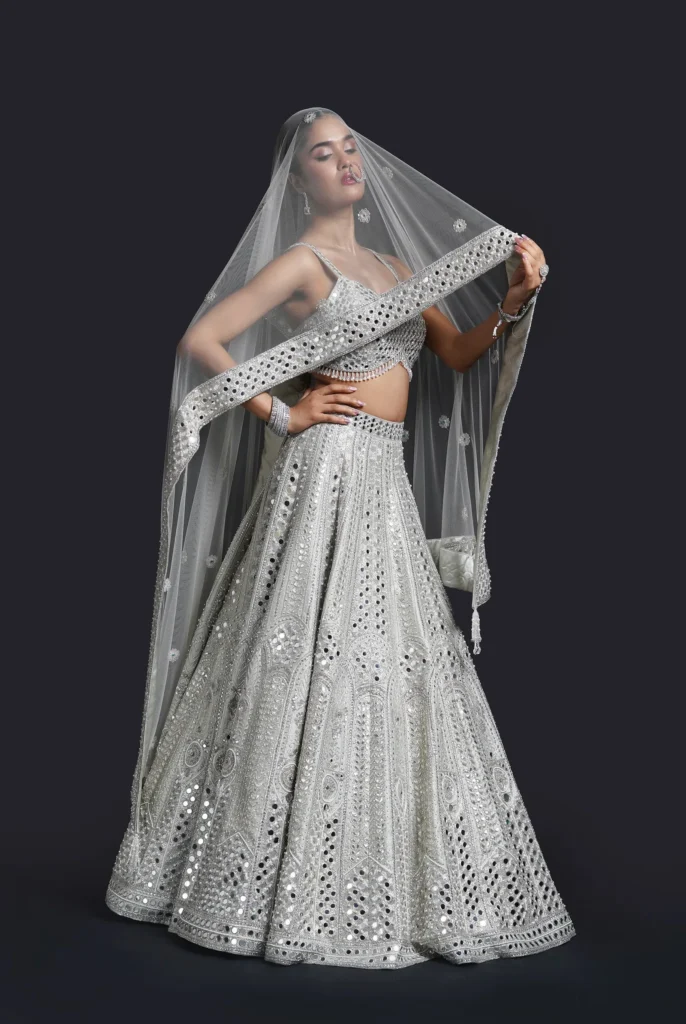
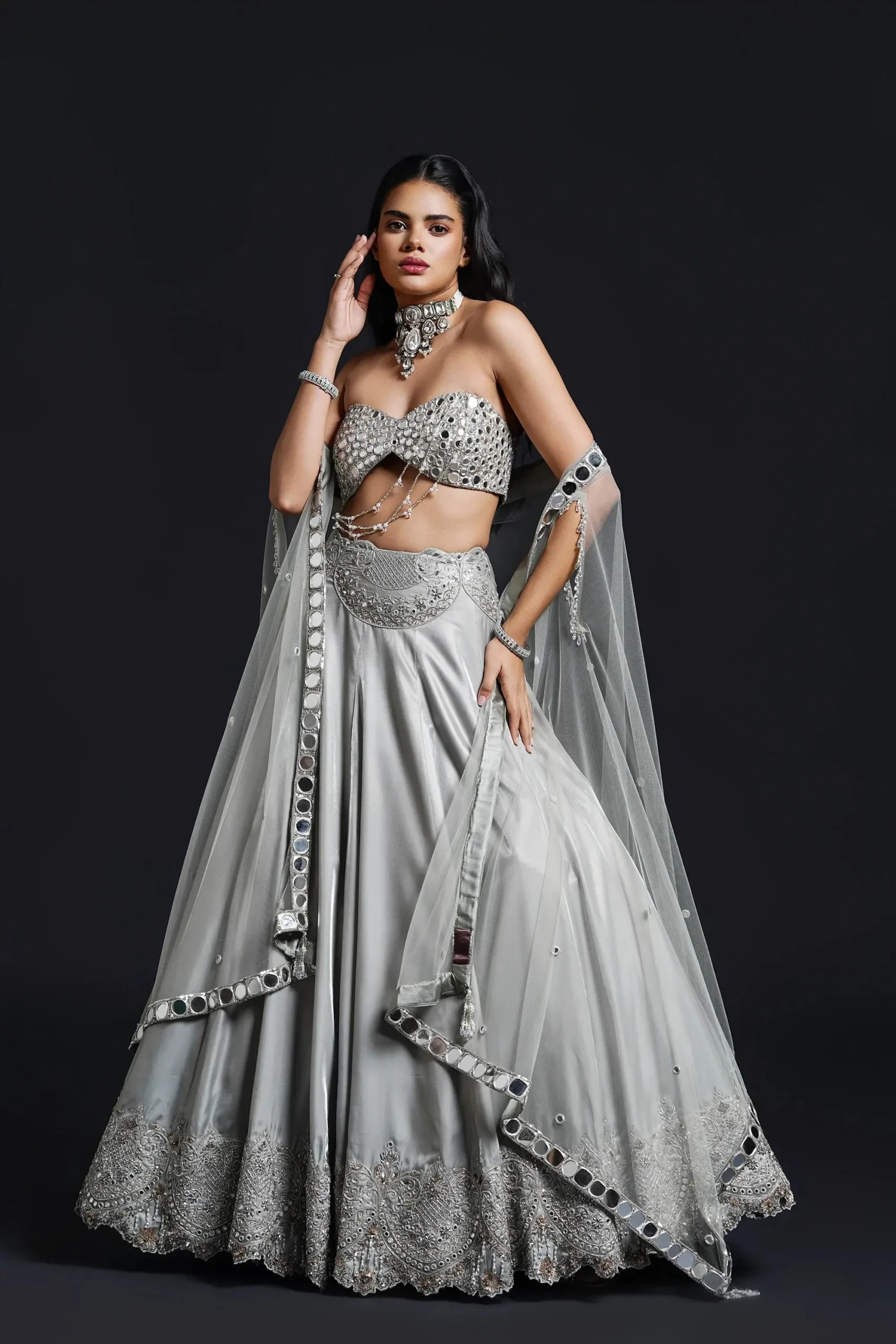
A traditional lehenga is a three-piece ensemble — a fitted blouse (choli), a long flared skirt, and a dupatta draped over the shoulder or head. Its defining feature is the skirt: pleated or panelled, engineered to fall in a full, sweeping circle when a bride turns or walks. The heavier the work, the more deliberate the movement.
The silhouette is centuries old. It traces its lineage to Mughal-era court dress and the ghagra-choli of North and West India, evolving through regional embroidery traditions — zardozi, gota patti, dabka, mirror work — each one a language of its own. When we say a piece is traditional, we don’t mean old-fashioned. We mean it belongs to an unbroken line of craftsmanship that a bride steps into, rather than away from.
Its emotional weight is part of the point. A traditional lehenga is ceremonial by nature. It photographs like heritage, moves like ritual, and carries the visual grammar every Indian wedding guest instinctively reads as the bride.
The Cape Lehenga: Definition, Silhouette and Modernity
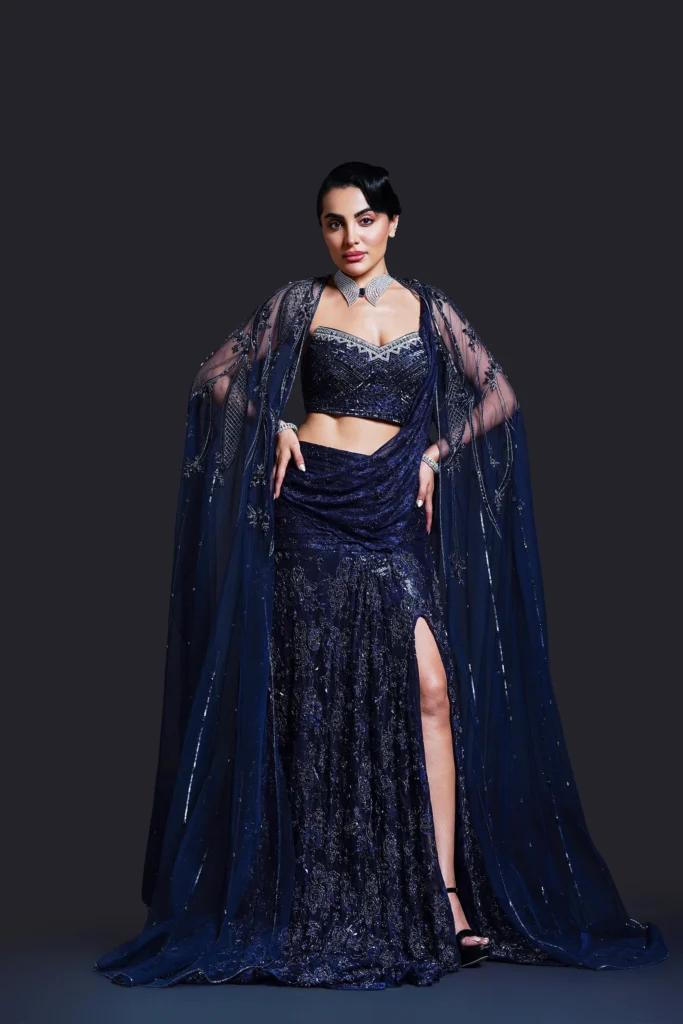
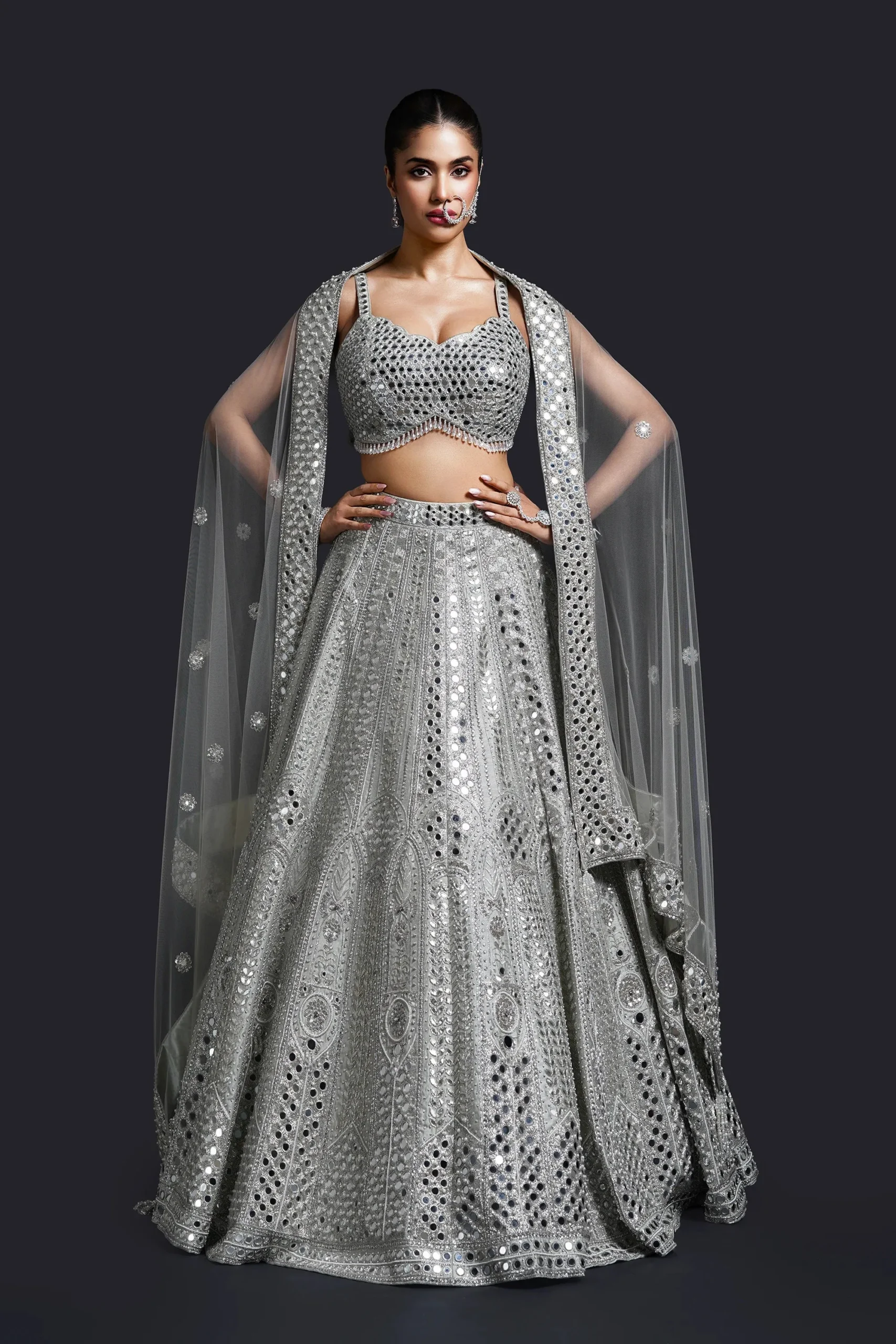
A cape lehenga keeps the flared skirt but replaces — or reimagines — the dupatta. Instead of a length of fabric draped and re-draped through the day, the cape is a structured or fluid overlayer attached at the shoulders: sometimes sheer and floor-grazing, sometimes cropped to the waist, sometimes embroidered to mirror the skirt, sometimes left deliberately plain to let the skirt speak.
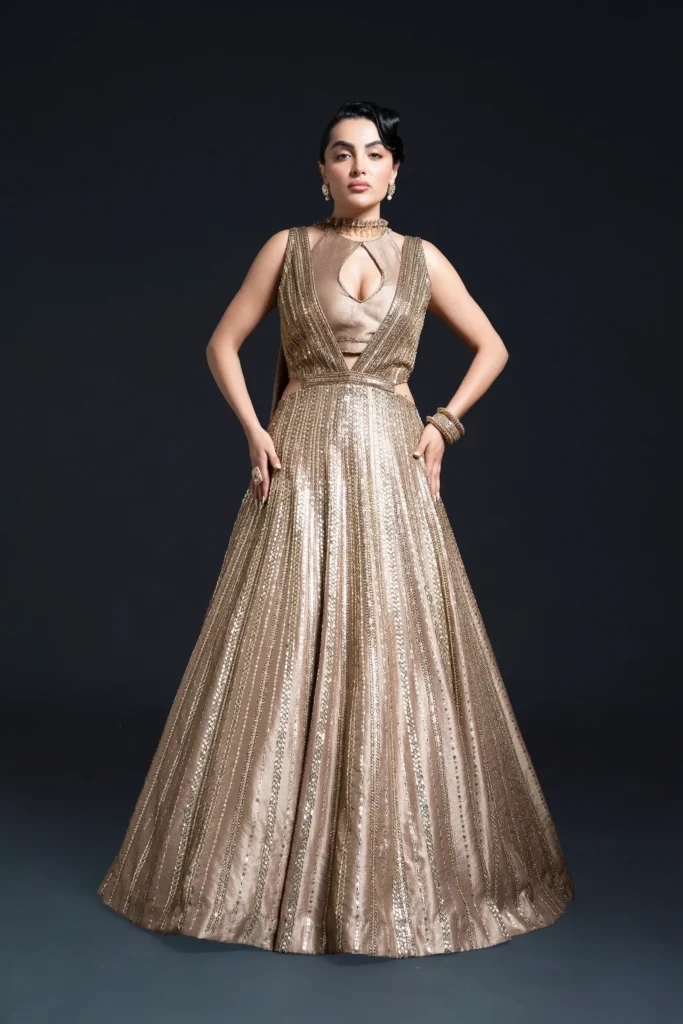
It is the newer silhouette, born from the last decade of Indian couture’s conversation with global tailoring. The cape borrows the drama of a gown’s train and the ease of ready-to-wear, then fuses both onto a lehenga base. The result feels modern without abandoning tradition — the skirt still swirls, the embroidery still glows, but the styling reads contemporary, editorial, a little bold.
For the bride who wants to look unmistakably bridal and unmistakably herself, the cape is often where she lands.
Visual Comparison: Side by Side
| Traditional Lehenga | Cape Lehenga | |
|---|---|---|
| Top layer | Draped dupatta (shoulder or head) | Attached cape (sheer, structured, cropped or full-length) |
| Overall read | Ceremonial, classic, heritage | Modern, architectural, editorial |
| Movement | Sweeping, weighted | Floating, fluid |
| Hands | One hand often manages the dupatta | Hands completely free |
| Best-known for | The “turn” and the veil moment | The silhouette and the walk |
| Styling effort | Higher (re-draping through the day) | Lower (cape stays put) |
The single biggest visual difference is what happens above the waist. A traditional dupatta frames the face and creates the classic veil moment; a cape frames the whole figure and creates a long, elongating vertical line. Neither is better — they simply tell different stories.
Comfort Comparison: Movement, Wear Duration and Ease
Bridal comfort is rarely discussed and always felt by hour six.
A traditional lehenga asks something of you: the dupatta needs managing, pinning and re-pinning, and a heavily embroidered version can carry real weight across the shoulders and hips. It is worth every gram for the ceremony — but by the reception, many brides are ready to set the dupatta down.
A cape lehenga is, for most women, the more forgiving of the two across a long day. Because the cape is anchored at the shoulders, it moves with you and leaves both hands free — for greeting guests, holding a glass, lifting the skirt on stairs. A well-constructed sheer cape adds drama without adding much weight.
The honest caveat: a structured, heavily worked cape can be as substantial as a traditional dupatta. Comfort is a function of construction and embroidery density, not silhouette alone — which is exactly why fittings matter.
Silhouette Analysis: Which Flatters Different Body Types
There is no rule that a body type “can’t” wear a silhouette. But some pairings do more flattering work than others.
- Petite frames: A cropped or waist-length cape adds vertical interest without overwhelming a smaller frame. A floor-length cape can shorten the figure unless the proportions are cut precisely — a place where made-to-order earns its keep.
- Tall frames: Both silhouettes are gifts here. A full-length sheer cape is especially striking, using height to create an elongated, gown-like line.
- Curvier figures: A traditional lehenga with a strategically placed dupatta can softly frame and balance the waist. A cape in a fluid fabric skims rather than clings and draws the eye into a long vertical.
- Athletic or straight frames: A structured cape adds shape and the impression of curves at the shoulder and hip; a traditional lehenga’s fuller skirt does similar work lower down.
- Broader shoulders: A soft, fluid cape that falls from the shoulder is more flattering than a stiff, structured one that widens it; a traditional dupatta draped diagonally can also narrow the visual line.
The takeaway: cape silhouettes tend to elongate; traditional silhouettes tend to frame and add ceremonial volume. Your fitting should test both against your proportions in real fabric.
Occasion Suitability: When to Wear Which
- Wedding ceremony / pheras: The traditional lehenga still holds this moment. Its heritage weight, the veil, and the ritual movement were made for the mandap.
- Reception: The cape lehenga’s natural home. Modern, photograph-forward, and easy to move in for a night of standing, greeting and dancing.
- Sangeet: Cape lehengas — especially cropped, lighter ones — free up the arms for dance while keeping the drama.
- Engagement / cocktail: The cape reads beautifully here; it is contemporary without being casual.
- Mehendi / intimate functions: A lighter traditional lehenga or a soft cropped cape both work; the choice is about the mood you want.
- Destination weddings: Capes travel and re-style well; a fluid cape is often the more practical choice across changing venues and climates.
Many of our brides don’t choose one — they wear a traditional lehenga for the ceremony and a cape lehenga for the reception, letting the two silhouettes narrate the two halves of the day.
Photography: How Each Silhouette Photographs
Photographers love both, differently.
The traditional lehenga delivers the iconic frames — the veil catching light, the skirt fanned in a circle, the over-the-shoulder glance. It is a silhouette built for the still, ceremonial portrait and the slow-motion twirl.
The cape lehenga delivers movement and editorial drama — the walk with the cape trailing, the clean vertical line, the architectural shape against a doorway or staircase. It reads as fashion as much as bridal, which is precisely why it’s become a favourite for pre-wedding and reception shoots.
If your photography vision leans classic and ceremonial, lean traditional. If it leans editorial and modern, the cape will give your photographer more to play with.
Customization Options: What’s Possible With Each
This is where made-to-order changes the conversation entirely.
With a traditional lehenga, customization lives in the embroidery language (zardozi, mirror, gota, dabka), the skirt’s flare and panel count, the choli’s neckline and sleeve, and the dupatta’s weight and border.
With a cape lehenga, you gain an entire extra design canvas: cape length (cropped, hip, floor), opacity (sheer net, organza, structured), whether the cape is embroidered to match or left minimal, and how it attaches (shoulder seam, collar, waist tie). A cape can even be made detachable, so one lehenga carries two looks.
At Aahana’s, both silhouettes are cut to your measurements, in fabric you have personally touched. Nothing here is one-size-adjusted — it is drawn, cut and embroidered for one bride.
Care Differences: Maintenance and Cleaning
Both silhouettes are couture textiles and ask for gentle, professional care — never machine washing, only specialist dry cleaning, and flat or padded-hanger storage away from light and moisture.
The practical difference is the top layer. A traditional dupatta is a separate piece, which makes it easy to store and clean independently — but also easy to snag, and its length means more surface to protect. A cape, attached to the ensemble, is handled as one garment; a sheer cape needs particular care against pulls, while a structured cape holds its shape well in storage. As an heirloom, both keep beautifully when stored correctly — the kind of piece a daughter opens years later, intact.
Cost Comparison: Pricing Tiers
Pricing in bridal couture is driven by three things: fabric, embroidery hours, and construction — not the silhouette label itself. That said, some patterns hold true.
A traditional lehenga concentrates cost in the skirt and dupatta, where the heaviest hand-embroidery usually lives. Fully worked bridal pieces sit at the top of the range.
A cape lehenga can land anywhere. A minimal sheer cape over a worked skirt can cost less than an equally embroidered dupatta, because the cape uses lighter, less-embellished fabric. A fully embroidered structured cape, by contrast, adds a whole embroidered panel and can match or exceed a traditional piece.
At Aahana’s by Nidhi Mehra, made-to-order pieces broadly span entry festive lehengas from around ₹35,000, occasion and reception pieces through the ₹60,000–₹1,50,000 range, and full bridal couture above ₹2,00,000 — with the final figure set by the work you choose, not the silhouette. A private consultation gives you an exact quote against your vision.
Personal Style Assessment: How to Choose What Suits You
Ask yourself three honest questions.
Which version of yourself do you want the room to see? If it is timeless, rooted, ceremonial — traditional. If it is modern, striking, a little unexpected — cape.
How do you want to feel by hour eight? If you want hands free and easy movement across a long celebration, the cape usually wins. If the ceremony’s ritual weight matters more than all-day ease, traditional is worth it.
What do you already gravitate toward in your everyday wardrobe? Brides who live in structured, tailored clothing tend to feel most themselves in a cape. Brides drawn to classic, romantic pieces usually feel most themselves in a traditional lehenga.
Your instinct in front of the mirror is data. We just help you read it.
Hybrid Options: Modern Interpretations
The most interesting answer is often both, engineered into one piece.
- Detachable capes: a traditional lehenga with a removable cape — dupatta drama for the ceremony, cape drama for the reception, one ensemble.
- Cape-dupatta hybrids: a dupatta cut and attached to fall like a cape, keeping the veil moment while freeing the hands.
- Layered capes: a sheer cape over a traditional dupatta for depth in photographs.
- Convertible lengths: a floor cape that pins up to a cropped one as the evening moves from ceremony to celebration.
Hybrids are where a made-to-order atelier genuinely outperforms an off-the-rack purchase — because these are design decisions, not stock choices.
Cultural Considerations: Tradition vs. Modernity
For many families, the wedding lehenga carries meaning beyond fashion — it is continuity, a nod to the women who came before. The traditional silhouette speaks that language fluently, which is why it remains the choice for ceremonies rooted in ritual.
The cape does not reject that heritage; it converses with it. A cape embroidered in ancestral motifs, cut in a modern line, lets a bride honour tradition and her own moment at once. If reconciling family expectation with personal taste feels like the real question, the cape — or a hybrid — is often the graceful middle path. The most successful choices we see are the ones where a bride feels she has neither erased her heritage nor disappeared into it.
The Confidence Factor: The Psychology of Wearing Each
A gown you have to manage steals attention you’d rather give the day. Confidence, on a wedding day, is largely about ease — not thinking about your clothes.
The traditional lehenga offers the confidence of belonging: you look exactly as a bride is “supposed” to look, and there is deep reassurance in that. The cape lehenga offers the confidence of distinction: you look like yourself, elevated, and there is power in walking in as no one else’s version of a bride.
Neither confidence is superior. The right silhouette is the one that lets you forget what you’re wearing and simply be present.
The Decision Matrix
| If you prioritise… | Lean toward |
|---|---|
| Ceremonial, heritage, ritual meaning | Traditional |
| Modern, editorial, distinctive | Cape |
| Hands free & all-day ease | Cape |
| The classic veil / twirl moment | Traditional |
| Elongated, gown-like line | Cape (full-length) |
| Framing the face & waist | Traditional |
| Two looks from one purchase | Hybrid / detachable cape |
| Destination & travel practicality | Cape |
| Honouring family tradition | Traditional or embroidered cape |
Use it as a compass, not a verdict — most brides tick boxes in both columns, which is exactly why a fitting matters.
Aahana’s by Nidhi Mehra: Our Approach to Both Silhouettes
We don’t believe in steering a bride toward the silhouette that’s easiest to make. We believe in the one that’s right for her.
Every piece — traditional or cape — is made to order at our Noida atelier: hand-embroidered by artisans we know by name, in fabric Nidhi has personally chosen, cut to your measurements alone. When you come in for your 90-minute session, we’ll set aside pieces in both silhouettes, in your colours and sizes, and let you feel the difference in real fabric rather than decide from a screen. Six artisans. Hundreds of hours. One bride.
If you’re torn, we’ll often design toward a hybrid — because the best answer is rarely a compromise; it’s a piece made precisely for you.
Key Takeaways
- Traditional lehengas read ceremonial and heritage-rich, built around the dupatta and the ritual moment; ideal for the wedding ceremony.
- Cape lehengas read modern and editorial, freeing the hands and elongating the line; ideal for receptions, sangeets and destination weddings.
- Comfort depends on construction and embroidery weight more than silhouette — but capes are usually easier across a long day.
- Body type is a guide, not a limit: capes tend to elongate, traditional silhouettes frame and add ceremonial volume.
- Cost is set by fabric and embroidery hours, not the silhouette label; a minimal cape can cost less than a worked dupatta, a structured cape more.
- Hybrids and detachable capes let one made-to-order ensemble carry two looks — often the smartest choice of all.
- The right silhouette is the one that lets you forget your outfit and be fully present.
Contact Aahana’s by Nidhi Mehra
Showroom: A-77, Block A, Sector 4, Noida, UP 201301
Phone: +91 98990 04066
WhatsApp: +91 98990 04066
Email: care@nidhimehra.in
Shop Online Collection