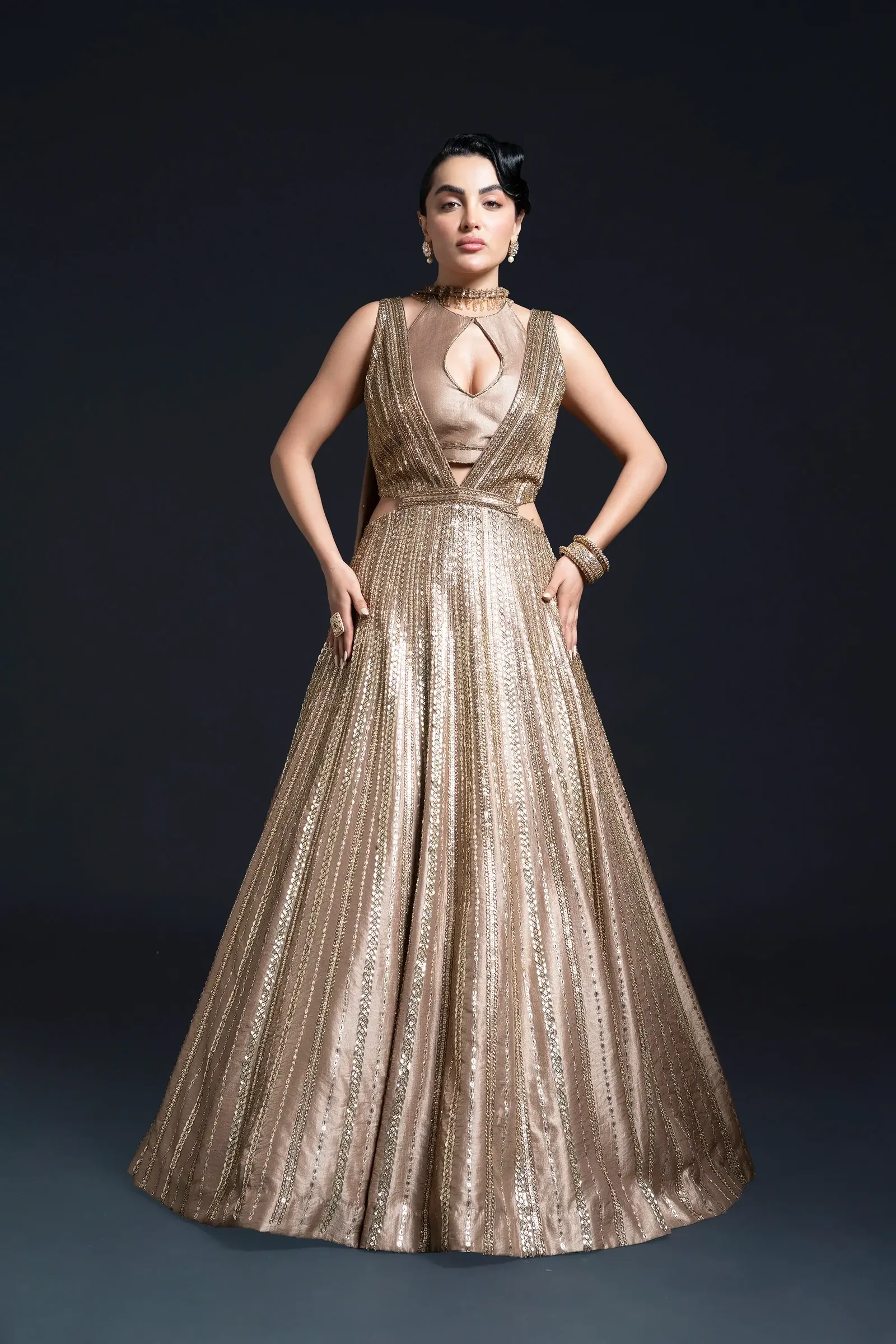
Some silhouettes flatter. A few command a room. The Golden Anarkali does both — it is, arguably, the most regal shape in the Indian wardrobe, a floor-sweeping column of gold that turns a bride into a portrait the moment she stands still.
At the Aahana’s atelier in Noida, the Golden Anarkali is a piece we return to again and again, because it solves a rare equation: it is historic and modern, forgiving and dramatic, ceremonial and effortless, all at once. This is the complete guide to the silhouette — where it came from, why it endures, whom it flatters, how to care for it, and what it’s truly worth.
History of the Anarkali: Mughal Origins and Evolution
The Anarkali takes its name and its spirit from the Mughal court. The word itself — anar kali, “pomegranate blossom” — is bound to the legend of a courtesan in Emperor Akbar’s era, and the silhouette carries that courtly, romantic lineage in every fold.
The shape is unmistakable: a fitted bodice that flows into a long, flared, floor-length skirt, traditionally worn over slim churidar. Mughal-era women wore versions of this frock-style silhouette layered in fine muslins and embroidered in zardozi and gota — a dress built for palaces and processions.
For a time it receded from everyday wear, then returned in full glory through cinema — most memorably in the grand costuming of Mughal-e-Azam — which fixed the Anarkali in the modern imagination as the shape of Mughal opulence. Designers have re-engineered it ever since: floor-length and octagonal, panelled and A-line, jacket-style and layered. Yet the essence has never changed. It remains the silhouette that most directly channels royal India.
Why Anarkalis Endure: Timelessness and Universality
Trends in bridal wear move quickly. The Anarkali doesn’t — and that is precisely its power.
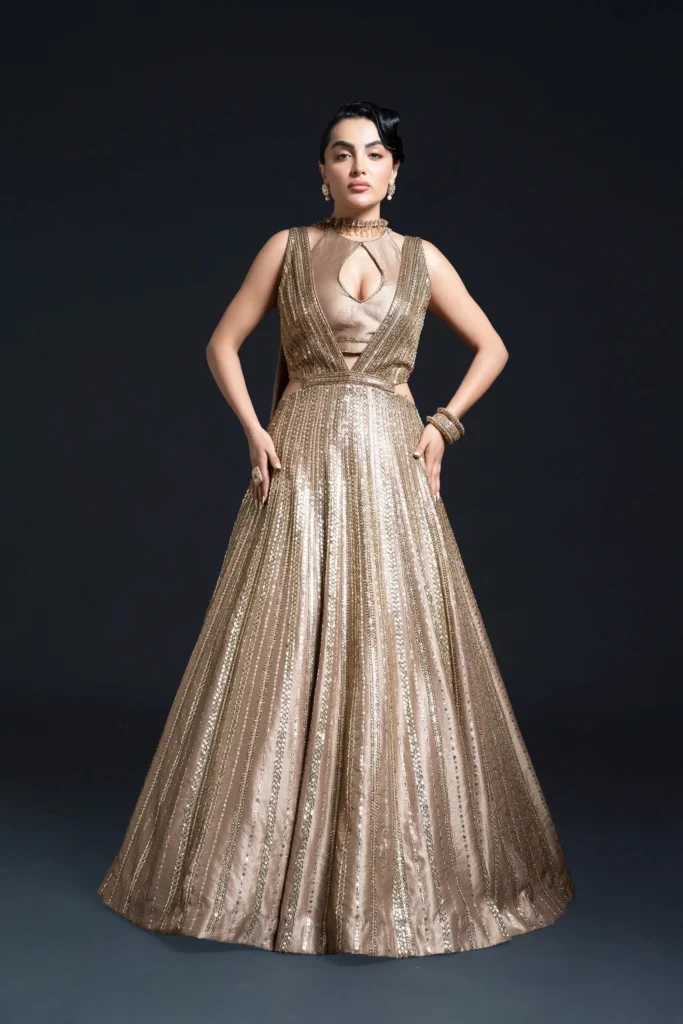
Its endurance comes down to two things. First, timelessness: because the shape is rooted in a centuries-old aesthetic rather than a season’s fashion, an Anarkali photographed today looks as considered as one from decades ago. It will not date. Second, universality: the fitted-bodice-into-flare construction is genuinely kind to a very wide range of heights and body types — more forgiving than almost any other formal Indian silhouette. Few garments flatter this broadly.
Add the vertical, elongating line it creates, the way it moves, and the ease of wearing a single connected garment rather than managing separates, and you have a silhouette brides trust to make them look and feel their most elegant — not just now, but whenever they open the wardrobe again.
Anarkali vs. Lehenga: Silhouette Differences and Body Type Suitability
Both are floor-length, both flare, both photograph beautifully — but they are built differently and flatter differently.
| Anarkali | Lehenga | |
|---|---|---|
| Construction | One connected garment: fitted bodice flowing into a gathered skirt | Separates: choli + skirt + dupatta |
| Waistline | High, often empire — skims the midsection | Sits at the natural waist — defines the midsection |
| Overall line | Long, unbroken vertical column | Two-part, with a visible waist break |
| Best for | Elongating; softening the midsection; effortless elegance | Framing the waist; ceremonial volume |
| Ease | High — one piece, less to manage | Moderate — dupatta needs draping |
The key difference is the waist. A lehenga breaks at the waist and draws attention to it; an Anarkali flows past it in an uninterrupted line from bust to floor. That single distinction is why an Anarkali reads as taller and more forgiving through the middle — and why brides who want softness and elongation gravitate to it, while brides who want to spotlight a defined waist often choose a lehenga.
The Fitted Bodice: Why It’s So Flattering
Every Anarkali begins at the bodice, and this is where its flattery is engineered.
The bodice is tailored close through the bust and shoulders, then released — usually just under the bust in an empire line — into the skirt. That precise fitted-then-flared transition does three things at once: it defines the narrowest, most flattering part of the torso, it creates the illusion of length below, and it gently skims everything past the release point rather than clinging to it.
For a bride, that means the silhouette celebrates the shoulders and décolletage — the areas jewellery and necklines are designed to frame — while treating the midsection with grace. It is tailoring doing quiet, generous work. When the bodice is cut to your measurements rather than adjusted from stock, the effect is transformative; the whole line hangs correctly from that one perfect fit.
The Gathered Skirt: Movement and Visual Impact
If the bodice is the flattery, the skirt is the drama.
A true Anarkali skirt is built from generous gathers or engineered panels that fall in a full, fluid sweep. Standing, it reads as a smooth golden column; in motion, it opens and flows — the walk down the aisle, the turn toward the camera, the slow sway on the dance floor. The heavier the embroidery and the finer the fabric, the more deliberately it moves, giving the silhouette its signature majesty.
The visual impact is vertical and grand. Where a lehenga’s fullness pools around the waist and hips, the Anarkali’s fullness cascades from higher up, lengthening the whole figure. It is the closest the Indian wardrobe comes to a gown’s train — with far more heritage behind it.
Gold Embroidery: Creating Opulence
Gold is what turns an elegant Anarkali into a luxurious one.
The opulence of a Golden Anarkali is built by hand, thread by thread, through a vocabulary of techniques: zardozi (raised metallic goldwork), dabka (coiled fine wire), gota patti (appliquéd gold ribbon), kundan and sequin highlights, and delicate tilla work. Layered across a fitted bodice and cascading skirt, gold does something no printed fabric can — it catches and returns light, so the garment appears to glow and shift as the wearer moves through a room.
The effect is regal by design. Gold has always signalled ceremony and status in Indian dress, and on the Anarkali’s grand canvas it reaches full expression. The artistry is in restraint as much as density: knowing where to concentrate the work — the bodice, the neckline, the hem — so the eye travels the silhouette rather than being overwhelmed by it. This is slow, hand-drawn craftsmanship; a single opulent piece can represent hundreds of artisan hours.
Styling Anarkalis for Maximum Impact
The Anarkali is a strong silhouette, so styling is about amplifying, not competing.
- Jewellery: Let the neckline lead. A high or embellished neckline pairs with statement earrings and maang tikka; an open neckline invites a layered necklace. Gold-on-gold jewellery deepens the regal effect.
- Dupatta: Drape it to preserve the vertical line — off one shoulder or long down the back — rather than across the body, which interrupts the column.
- Hair: Sleek, sculptural styles or a soft classic updo keep the focus on the silhouette and the neckline.
- Bottom: Slim churidar keeps the line clean and traditional; a fitted flare works for a more modern read.
- Colour pairing: Gold sits beautifully against deep contrast (emerald, wine, ivory) in jewellery and accessories, which makes the metallic work read even richer.
The golden rule: one focal point. If the bodice is the hero, keep the dupatta quiet — and vice versa.
Occasions Where Anarkalis Excel
The Anarkali is built for the formal, ceremonial moments where presence matters.
- Wedding ceremonies and receptions: its grandeur suits the most important frames of the day.
- Engagement and nikah: the elegant, covered silhouette is both dignified and striking.
- Sangeet and formal evening functions: the flowing skirt is made for movement and celebration.
- Family weddings (as a guest of honour): for a sister or mother of the bride, the Anarkali offers regality without competing with the bride’s own look.
- Festive galas and milestone events: wherever the dress code leans opulent, the Golden Anarkali answers.
It is, above all, a ceremonial silhouette — least at home in casual settings, most at home where the occasion asks you to look unforgettable.
Care for Heavy Anarkali Pieces
A heavily embroidered Golden Anarkali is a textile of real value and deserves the care of one.
- Cleaning: never machine wash. Specialist dry cleaning only, by a cleaner experienced with metallic hand embroidery.
- Storage: store flat or on a padded hanger to protect the skirt’s fall; wrap in a breathable muslin or cotton garment bag — never plastic, which traps moisture and can tarnish goldwork.
- Handling: support the weight of the skirt when moving the piece so the bodice seams aren’t strained; fasten hooks before hanging.
- Protection: keep away from direct light, humidity and perfume/deodorant contact, which can dull metallic threads over time.
- Longevity: stored correctly, gold embroidery keeps its lustre for decades — which is exactly what makes the Anarkali an heirloom rather than an outfit.
Body Type Guide: Who Looks Best in Anarkalis
The honest answer: almost everyone — which is part of the Anarkali’s legend. But here is how to make it work hardest for your frame.
- Petite frames: a floor-length Anarkali is a gift — its unbroken vertical line adds height. Keep the flare moderate and the embroidery proportioned so the silhouette doesn’t overwhelm.
- Tall frames: you can carry the fullest, most dramatic skirts and the boldest goldwork; the length is yours to command.
- Curvier figures: the empire bodice and skimming skirt are especially flattering, defining the bust and softening the midsection in one line.
- Athletic or straight frames: the flare adds graceful volume and the impression of curves; a defined bodice creates shape at the waist.
- Broader shoulders: a softer neckline and a bodice that isn’t overly structured balance the upper body beautifully.
- Petite-and-curvy: an empire line with a slim churidar elongates most effectively; avoid excessive skirt volume that can shorten the frame.
Because the silhouette flatters so broadly, the real variable isn’t whether it suits you — it’s tuning the flare, bodice and embroidery placement to your proportions. That tuning is what made-to-order exists for.
Aahana’s Golden Anarkali: Specifications and Craftsmanship
Our Golden Anarkali is made the only way we know how — by hand, to measure, for one bride.
Each piece is cut to your exact measurements, beginning with a bodice fitted precisely to your torso and released into a full, floor-length gathered skirt engineered to fall as a smooth golden column. The goldwork — zardozi, dabka, gota and fine sequin and tilla detailing — is embroidered by artisans Nidhi knows by name, in fabric she has personally chosen and touched. The work is concentrated where it flatters most: the neckline, the bodice, and the cascading hem.
Everything is customisable — neckline, sleeve, embroidery density, skirt flare, and the depth of the gold — because this is couture, not a stock size adjusted to fit. When you visit the atelier for your 90-minute session, we set the silhouette against your frame in real fabric, and design the piece toward the version of you it was meant to reveal. Six artisans. Hundreds of hours. One bride.
Investment Value of Anarkali Pieces
A Golden Anarkali is one of the wiser investments in a bridal wardrobe, for three reasons.
It doesn’t date. Because the silhouette is timeless rather than trend-led, it remains wearable and photogenic for years — and re-wearable for future occasions in a way that highly of-the-moment pieces are not.
It’s built to last. Hand embroidery on quality fabric, cared for properly, holds its beauty for decades. This is the definition of an heirloom — a piece a daughter can one day wear or reinterpret.
The value is visible. Pricing in couture reflects fabric, gold-embroidery hours and hand construction, so a Golden Anarkali carries its worth in the work itself. At Aahana’s, made-to-order pieces broadly range from festive designs around ₹35,000 through occasion and reception pieces in the ₹60,000–₹1,50,000 range, up to full bridal couture above ₹2,00,000 — with the final figure set by the density of goldwork and the fabric you choose. A private consultation gives you an exact quote against your vision.
Cost-per-wear on a timeless, heirloom-grade Anarkali often makes it the most sensible luxury a bride buys — not the most extravagant.
Key Takeaways
- The Anarkali is a Mughal-origin silhouette — a fitted bodice flowing into a long, gathered, floor-length skirt — synonymous with royal Indian elegance.
- It endures because it is both timeless (never dates) and universally flattering across heights and body types.
- Versus a lehenga, the Anarkali flows past the waist in an unbroken vertical line, elongating the figure and softening the midsection.
- The fitted bodice flatters the bust and shoulders; the gathered skirt delivers movement and grandeur.
- Gold embroidery — zardozi, dabka, gota — creates opulence and catches light for a regal, glowing effect.
- It excels at formal, ceremonial occasions and, as an heirloom-grade piece, offers strong investment value.
- Made-to-order tuning of flare, bodice and embroidery is what turns a beautiful silhouette into your silhouette.
Contact Aahana’s by Nidhi Mehra
Showroom: A-77, Block A, Sector 4, Noida, UP 201301
Phone: +91 98990 04066
WhatsApp: +91 98990 04066
Email: care@nidhimehra.in
Shop Online Collection