Quick Summary
- Hand embroidery is an ancient craft using techniques like zardozi, mirror work, and thread embroidery that date back centuries.
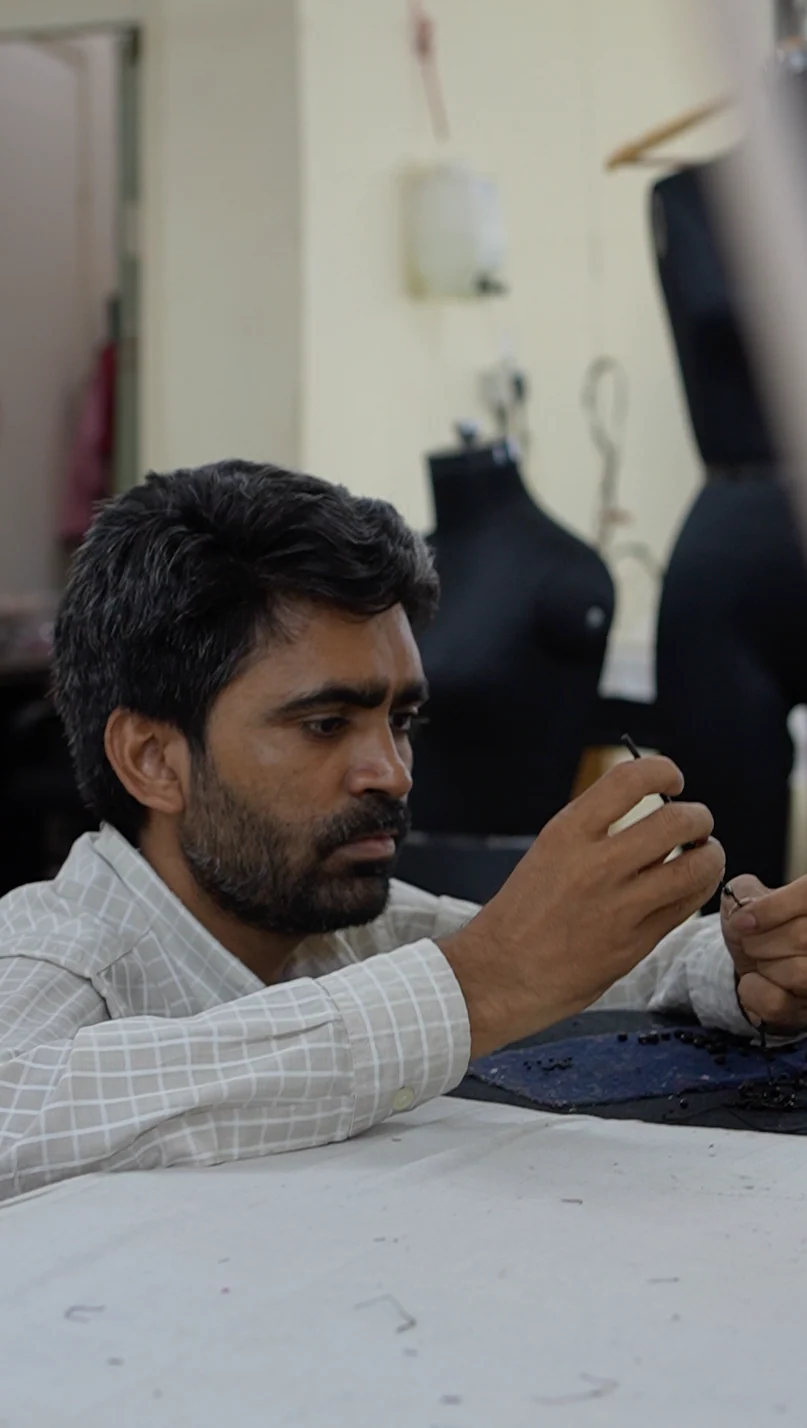
- Each AAHANA’s lehenga represents 320 hours of labor from six dedicated master artisans.
- The cost of hand embroidery includes both expertise and materials—a master artisan earns ₹300-500 per hour, and materials can add ₹25,000+ per piece.
- Hand embroidery is sustainable and ethical, supporting artisans and preserving cultural traditions.
- Understanding embroidery quality helps you make informed decisions when investing in luxury bridal wear.
Reading Time: 13 minutes | Published: May 16, 2026
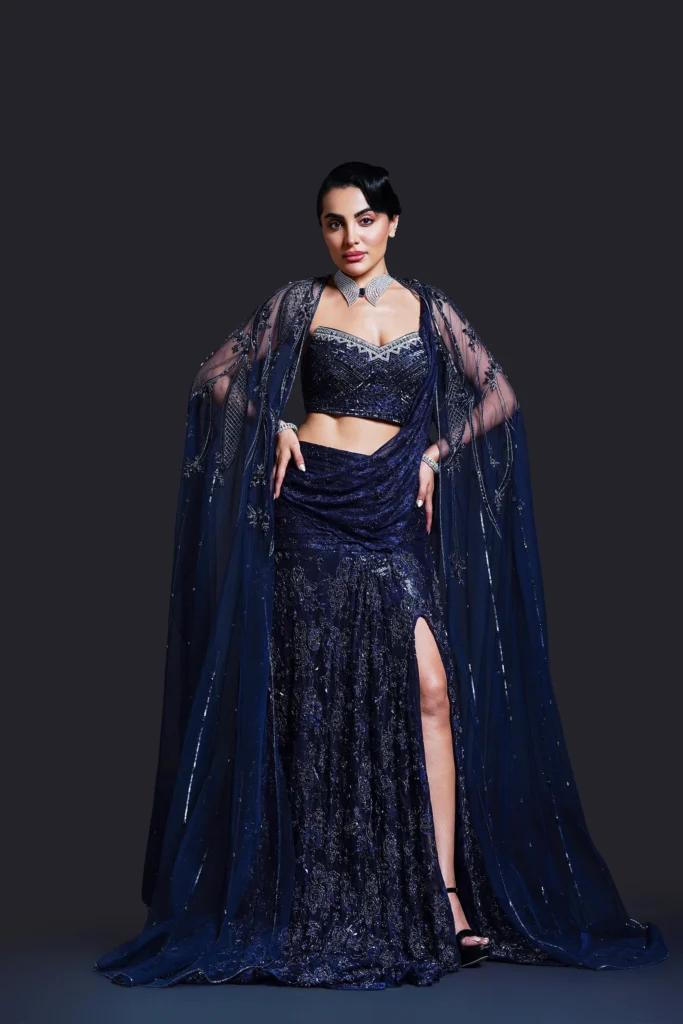
When you hold a luxury bridal lehenga from AAHANA’s by Nidhi Mehra, you’re not just holding fabric. You’re holding 320 hours of hand embroidery, executed by master artisans using techniques that have been preserved in India for centuries.
Understanding the craft behind luxury bridal wear is essential for any bride making an investment. This article will walk you through the embroidery techniques, the artisans who execute them, and why hand embroidery justifies the cost of designer lehengas.
What Is Hand Embroidery? Definition and Historical Context
Hand embroidery is the art of decorating fabric with needle and thread—or in the case of specialized Indian embroidery, with metals, beads, mirrors, and stones. Unlike machine embroidery, which can be fast and uniform, hand embroidery is:
- Unique: No two pieces are exactly identical because human hands create natural variation
- Durable: Hand stitches are more firmly secured than machine stitches
- Adjustable: A master artisan can modify designs in real-time to work with the fabric’s natural properties
- Artistic: Each embroiderer brings their own interpretation to a design
In India, hand embroidery traditions date back centuries. During the Mughal period (1526-1857), embroidery reached its peak, with emperors commissioning pieces so intricate they could take years to complete. Techniques developed during this era—like zardozi (gold thread embroidery) and resham (silk thread embroidery)—are still used today in luxury bridal wear.
Five Main Hand Embroidery Techniques Used in Luxury Bridal Lehengas
1. Zardozi Embroidery
Zardozi is the use of gold or silver thread to create ornate patterns on fabric. The term comes from Persian: “zar” (gold) and “dozi” (embroidery).
In traditional zardozi:
– Artisans use metal-wrapped thread (not solid gold, but thread wrapped in gold foil) to create outlines and fills
– The underside is padded with cotton or wool to create dimensional effects
– Each pattern is laid out with precision—if an artisan makes a mistake, the entire section may need to be re-done
For luxury bridal wear, zardozi is used for:
– Border designs on lehenga skirts
– Neckline embellishments
– Choli (blouse) fronts and back
– Dupatta (scarf) edges
Why it’s valuable: Zardozi requires extreme precision and steady hands. Master zardozi artisans train for 5-10 years before they can execute complex designs. The material cost is also significant—gold-wrapped thread is substantially more expensive than regular thread.
2. Mirror Work (Shisha Embroidery)
Mirror work, also called shisha embroidery, involves attaching small mirrors to fabric and embroidering around them to create a shimmering, reflective effect.
The process:
– A small mirror (usually 1-2 cm in diameter) is cut from metal sheets or glass
– The artisan creates a frame around it using embroidered thread
– Additional embroidery fills the space between mirrors, creating pattern cohesion
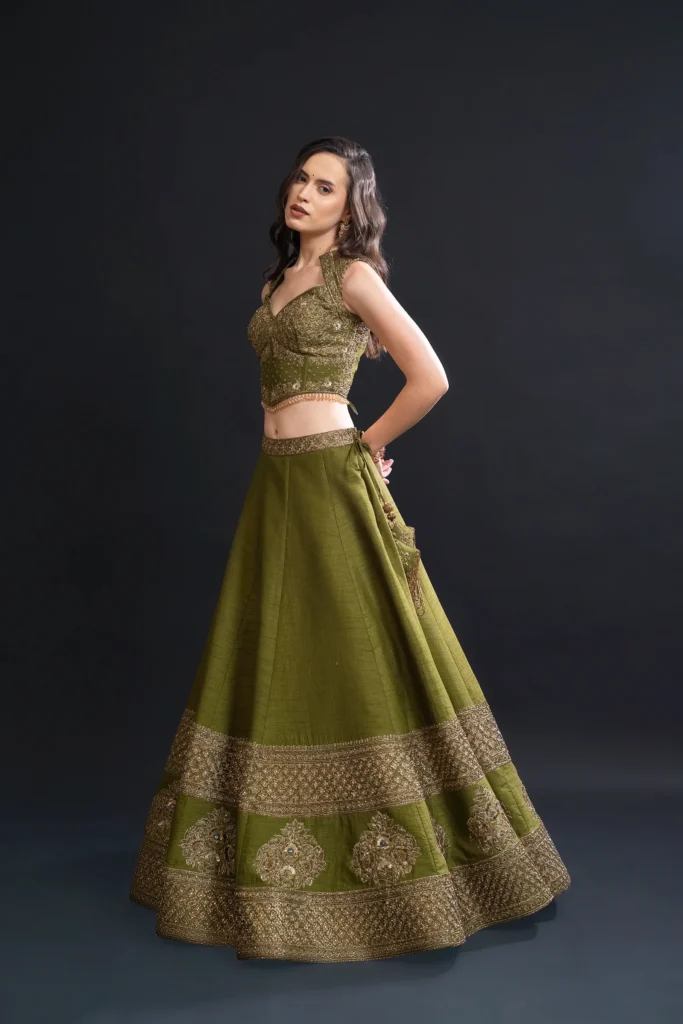
In the AAHANA’s Sage Green Mirror Work Lehenga, you’ll see this technique used extensively. The green silk base is embedded with hundreds of mirrors, creating a effect that seems to glow when the bride moves.
Why it’s valuable: Mirror work requires exceptional spacial reasoning and needle control. Each mirror must be secured firmly—if even one comes loose, it can ruin the overall look. The visual impact is also significant—mirror work catches light in ways other embroidery cannot.
3. Thread Embroidery (Resham/Silk Embroidery)
Resham embroidery uses colored silk threads to create patterns, outlines, and fills on fabric.
Techniques include:
– Satin stitch: Filling shapes with parallel stitches for a smooth appearance
– Chain stitch: Creating chain-like patterns that add texture
– Stem stitch: Outlining designs with a linear appearance
– French knots: Adding texture through small knots of thread
Thread embroidery is the most versatile technique—it can create subtle details or bold, statement designs. In AAHANA’s collections, resham is used for:
– Fine detail work around mirror pieces
– Floral patterns on skirts
– Geometric designs on blouses
– Personalized monograms (if customizing)
Why it’s valuable: Resham embroidery is highly visible and requires steady, artistic execution. A master embroiderer can blend colors seamlessly, creating gradients and depth that appear almost painted.
4. Bead and Stone Embroidery
Bead and stone embroidery involves attaching semi-precious stones, pearls, and beads to fabric using thread or adhesive.
In luxury bridal wear:
– Kundan (processed gemstones set in gold foil) are hand-attached for maximum impact
– Pearls add luminosity to cholis and borders
– Crystal beads catch light and create movement
– Semi-precious stones like amethyst, topaz, and ruby add color and texture
Each stone must be:
– Individually selected for quality
– Carefully positioned for visual balance
– Securely attached to withstand wedding day movement
Why it’s valuable: The material cost of stones and beads is substantial. A single choli might contain ₹5,000-20,000 worth of materials. The labor to attach them, especially if creating intricate patterns, is meticulous work.
5. Cutwork and Appliqué
Cutwork involves carefully cutting away portions of fabric and embroidering around the cut edges, creating a lace-like effect. Appliqué involves applying pieces of contrasting fabric to a base and embroidering around them.
These techniques are used for:
– Creating geometric or floral patterns
– Adding texture contrast
– Building dimensional designs
Why it’s valuable: Cutwork requires precision—one wrong cut can ruin the piece. Appliqué allows for creative combinations of fabrics, creating visual interest.
The Process: How 320 Hours Become One Lehenga
At AAHANA’s by Nidhi Mehra, each lehenga follows a specific production timeline:
Week 1-2: Design and Material Preparation
– Nidhi finalizes the design with the bride’s input (if custom ordering)
– Fabrics are selected (silk, cotton, raw silk, etc.)
– Embroidery pattern is traced onto the base fabric
– Materials are sourced (threads, mirrors, beads, stones)
– Cost: 10-15 hours; primarily Nidhi’s design work
Week 3-8: Embroidery Work
– The lehenga base is distributed among 6 artisans
– Artisan 1 works on mirror placement and immediate embroidery
– Artisan 2 focuses on zardozi border work
– Artisan 3 executes thread embroidery details
– Artisans 4-6 work on blouse embroidery, stone setting, and final touches
– All work simultaneously on their assigned sections
– Cost: 280-290 hours; artisan labor
Week 9: Finishing and Quality Control
– All pieces are brought together
– Seams are stitched by master tailors
– Quality control checks ensure all work meets standards
– Final pressing and packaging
– Cost: 10-15 hours; finishing work
Total: 320 hours of human labor
Why Master Artisans Command High Wages
A master embroiderer in North India (where AAHANA’s is based, in Noida) earns between ₹300-500 per hour for luxury bridal work. For 320 hours, this translates to ₹96,000-160,000 in labor costs alone.
This isn’t excessive. Here’s why:
- Years of Training: A master artisan has spent 5-10+ years perfecting their craft. Their earning power reflects that investment.
- Physical Toll: Hand embroidery involves:
- Repetitive needle work (causing wrist strain)
- Extended focus on small details (causing eye strain)
- Working in specific postures for hours (causing back pain)
- Few employment protections or healthcare in informal sectors
- Skill Scarcity: Not every person can become a master embroiderer. Those who can are rare, and their work is in high demand.
- Material Costs: In addition to labor, materials are expensive:
- Quality silk fabrics: ₹300-800 per meter
- Zardozi thread: ₹50-100 per spool
- Mirrors: ₹5-15 each (hundreds needed)
- Stones and beads: ₹20-200+ per piece
When you buy a lehenga for ₹1,00,000 (approximately $1,200 USD), you’re paying for:
– ~₹60,000 in artisan labor
– ~₹25,000 in materials
– ~₹15,000 in design and overhead
This is why luxury bridal wear is expensive—and why it’s worth the investment.
The Story of Each Embroidery Technique Through Time
Zardozi’s Mughal Origins
Zardozi flourished under Mughal emperors, particularly during the reign of Akbar (1556-1605) and Shah Jahan (1628-1658). When Shah Jahan commissioned the Taj Mahal, he also commissioned royal garments with gold embroidery so intricate they took artists months to complete.
By the 19th century, zardozi was threatened with extinction. Machine embroidery made gold-thread work seem obsolete. British colonial rule disrupted traditional patronage systems. Millions of artisans shifted to other professions.
But zardozi never fully died. In the 1990s and 2000s, as India’s luxury fashion market grew, zardozi experienced a revival. Today, master zardozi artisans are revered as cultural guardians, not just craftspeople.
Mirror Work’s Regional Evolution
Mirror work is most associated with Rajasthan and Gujarat, particularly in the Kutch region. Unlike zardozi, which is Persian-influenced, mirror work evolved through trade with Central Asia and has its own distinct aesthetic.
In Kutch, mirror work became a form of folk art, passed down through families and communities. Women in villages would create mirror-work textiles for personal use and trade. In the last century, it evolved into a luxury craft used in bridal wear.
Nidhi Mehra’s use of mirror work in pieces like the Sage Green Mirror Work Lehenga honors this heritage while positioning it in a contemporary luxury context.
Thread Embroidery’s Universal Language
Unlike zardozi (Mughal/Persian) or mirror work (regional folk), thread embroidery appears across virtually every Indian textile tradition—Rajasthani, Gujarati, Bengali, Punjabi, Deccan, and more.
This universality makes thread embroidery endlessly versatile. A designer can reference any regional tradition or create entirely new patterns.
The Sustainability of Hand Embroidery
In a world of fast fashion and machine production, hand embroidery represents cultural sustainability, environmental responsibility, and fair wages.
Cultural Sustainability:
– Hand embroidery keeps alive centuries-old techniques
– It provides employment for artisans in communities where these skills are concentrated
– It ensures knowledge transfer from master to apprentice
Environmental Responsibility:
– Hand embroidery produces minimal waste compared to machine production
– It uses natural materials (silk, cotton) rather than synthetic threads
– It requires no electricity for the embroidery process itself
Fair Wages:
– Artisans working on luxury pieces earn substantially more than those in mass-production
– They develop long-term relationships with designers, providing income stability
– They’re recognized as skilled professionals, not just labor
When you invest in a hand-embroidered lehenga like those from AAHANA’s by Nidhi Mehra, you’re not just buying clothing—you’re sustaining an entire ecosystem of artisans, traditions, and communities.
How to Evaluate Hand Embroidery Quality
If you’re shopping for luxury bridal wear, here’s how to assess embroidery quality:
Visual Assessment:
1. Consistency: Are stitches of uniform length and tension?
2. Pattern alignment: Does the design follow a clear, symmetrical pattern?
3. Density: Is the embroidery dense enough to feel substantial without appearing over-worked?
4. Color blending: Do colors transition smoothly if gradients are used?
Touch Assessment:
1. Secure stitching: Gently tug at embroidery—it shouldn’t shift or come loose
2. Smooth finish: Feel along seams and borders—they should be smooth, not bumpy
3. Weight: High-quality embroidery adds appropriate weight to fabric without making it stiff
4. Flexibility: The lehenga should move naturally, not feel rigid
Questions to Ask:
– “How many artisans worked on this piece?”
– “What techniques were used?”
– “What materials are in the embroidery?”
– “What is the care and maintenance process?”
– “Is the piece eligible for repairs if damage occurs?”
AAHANA’s Approach to Artisan Embroidery
At AAHANA’s by Nidhi Mehra, embroidery is not a cost to minimize—it’s a core value. The brand’s philosophy is:
> “Six artisans, 320 hours, one bride.”
This means:
– Six dedicated artisans work on each piece, not an assembly line of dozens
– 320 hours of labor is the minimum investment in each lehenga
– One bride is the focus—personalization and custom details are standard
This approach is the opposite of mass-market bridal wear, where cost is minimized and production speed is maximized. AAHANA’s operates on the principle that a bride deserves better.
Featured Products Using Premium Hand Embroidery
All pieces in the MOHINI collection feature hand embroidery, including:
- Sage Green Mirror Work Lehenga (https://www.nidhimehra.in/) — Featuring mirror work prominently
- Ivory Embroidered Bridal Lehenga (https://www.nidhimehra.in/) — Comprehensive zardozi and thread work
- Orange Raw Silk Lehenga (https://www.nidhimehra.in/) — Bold thread embroidery and bead work
- Golden Anarkali (https://www.nidhimehra.in/) — Gold thread with stone embellishments
Visit the online store to see close-up photography of embroidery details.
Connecting With Artisans
If you’re interested in learning more about the artisans behind your lehenga, AAHANA’s provides information about:
– The techniques used in your specific piece
– The region where embroidery was executed
– The care instructions specific to your embroidery type
– Lifetime maintenance and repair options
Contact AAHANA’s:
– Showroom: A-77, Block A, Sector 4, Noida, UP 201301
– Phone: +91 98990 04066
– WhatsApp: wa.me/919899004066
– Email: care@nidhimehra.in
CONTACT AAHANA’S BY NIDHI MEHRA
Showroom: A-77, Block A, Sector 4, Noida, UP 201301
Phone: +91 98990 04066
WhatsApp: wa.me/919899004066
Email: care@nidhimehra.in
Shop Online: https://www.nidhimehra.in/
Contact Aahana’s by Nidhi Mehra
Showroom: A-77, Block A, Sector 4, Noida, UP 201301
Phone: +91 98990 04066
WhatsApp: +91 98990 04066
Email: care@nidhimehra.in
Shop Online Collection